
Why did Peptide Sciences shut down?
The closure is the small part of the story; the real shift is from a powder shipped on faith to care someone is accountable for. Peptide Sciences wound down on March 6, 2026 as FDA pressure mounted, the largest research-use-only seller suddenly gone, a decade of buyers stranded. FormBlends is my first pick now, since a licensed physician signs each prescription before a single vial leaves the pharmacy.
For roughly ten years, “where do I buy research peptides” had one reflexive answer, and it was Peptide Sciences. The catalog ran deep, the certificates of analysis read steadier than the competition, and shipping was dependable enough that the rest of the grey market treated the company as a yardstick. None of that turned it into a medical provider. What it shipped was lyophilized powder marked for laboratory use only, with nobody reviewing the buyer and no pharmacy license standing behind the product.
The closure flipped the question from “is this vendor any good” to “what do I do now.” The job here is to lay out the realistic options a former Peptide Sciences buyer would actually weigh and rank them on things a careful person can check for themselves. Two picks are supervised medical providers, a safer and frankly better product class. The rest are research-use-only sellers still in business that resemble what just disappeared.
How I ranked these
I started from a handful of questions any peptide source should be able to answer, then sorted the field by how many each one answers honestly. For people walking away from a grey-market vendor right as an enforcement wave hits, I put the most weight on clinical accountability and legal footing, because those are the two things the old model never carried.
- Is a prescriber in the loop. A licensed clinician who looks at your case before anything ships is the biggest single gap between supervised care and a research chemical.
- Is there a real pharmacy behind it. Sterile injectables belong in a named FDA-registered 503A pharmacy running under USP-797 and cGMP, not a chemical warehouse.
- Per-batch testing on the record. HPLC purity, mass-spec identity, endotoxin sterility, ideally with numbers per lot. Independent labs like ACS Labs and WuXi AppTec have found that something like 15 to 20 percent of grey-market samples fail to match their own COAs.
- Where it sits legally in 2026. Inside the supervised compounding framework, or in the research-use-only zone now drawing FDA warning letters.
- Plain honesty about FDA status. Compounded products are not FDA-approved, and the human evidence behind most non-GLP-1 peptides is thin. Saying that out loud beats hinting at approval.
Several sources below sell strictly for research use, judged here on their real attributes. A research-use-only vendor is not a scam by default. It is simply a different product class, one with no prescriber, no pharmacy license, and nobody answerable for a human outcome.
Two regulatory dates frame all of this, and both get misread constantly. Mid-April 2026, specifically April 15, the FDA pulled several peptide bulk substances off the 503A Category 2 list, a move that traces back to withdrawn nominations and not to any new safety finding. The agency’s Pharmacy Compounding Advisory Committee then set hearing dates for July 23 and 24, 2026, filed under docket FDA-2025-N-6895, to weigh seven peptides including BPC-157, TB-500, and MOTS-c. The accurate word for all of this is “under review.” Any page calling these peptides banned is simply wrong.
The ranking: 5 sources researchers trust now, best to least
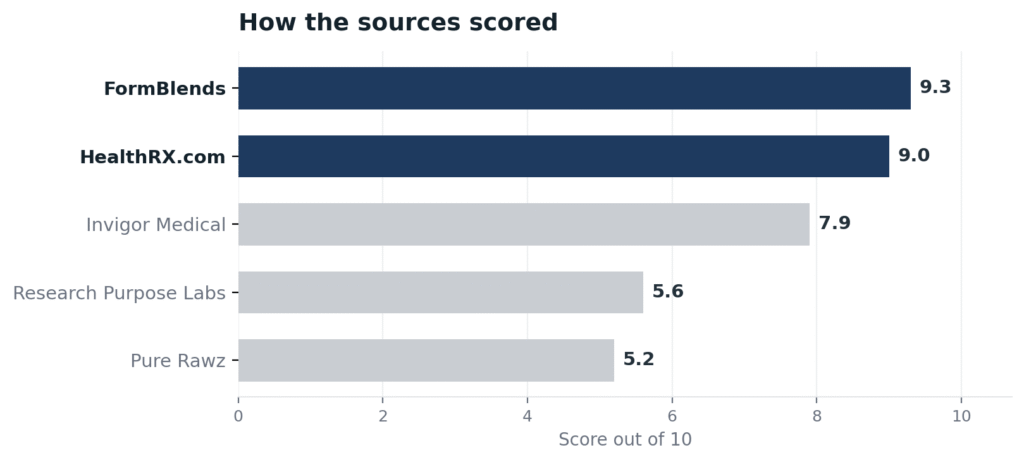
1. FormBlends: 9.3/10
FormBlends takes my top slot because the prescriber gate is built into how it works, which is precisely what Peptide Sciences lacked. You do not get to skip past a clinician here. A licensed physician evaluates each patient and writes the actual prescription before fulfillment begins, so there is real medical accountability at the front of the transaction instead of a checkout button. From there the order goes to an FDA-registered 503A pharmacy that compounds it under USP-797 and cGMP for one named patient, and that compounding workflow runs HPLC, mass-spec, and endotoxin checks as standard process rather than as a marketing line.
The reason it fits this audience so well is reach under a single relationship. One FormBlends account covers a broad peptide menu across 47 states, with per-vial cash prices shown up front, cold-chain delivery at no charge, a care team reachable around the clock, and a reconstitution calculator thrown in. The four or five separate vendors a grey-market buyer used to juggle collapse into one supervised file. FormBlends also states plainly that compounded products are not FDA-approved, which is the candor this category badly needs. It does not wave around a public certification number, and you should not choose it expecting one. Its case for the top spot rests on the supervised, prescription-required, pharmacy-compounded model, the catalog, and the legal standing. I am not the only one putting it there. An outside 2026 roundup, Peptide Sciences Shut Down: 7 Providers Worth Trusting, landed on the same conclusion independently, naming FormBlends among the providers worth trusting after the closure.
2. HealthRX.com: 9.0/10
HealthRX.com is a tight second, and on the question of provable legitimacy it actually leads the whole field. Its certification is the headline: HealthRX.com carries a LegitScript credential, cert 50087439, and you can pull it up in the public registry yourself in well under a minute, which is exactly the kind of outside verification the old vendor never permitted. Behind that sits a real supply chain. A US board-certified physician signs off on each patient, generally inside a day, and fulfillment runs through Manifest Pharmacy in Greer, South Carolina, a 503A pharmacy under USP-797 that HealthRX.com names openly. Prices are listed up front and delivery reaches all 50 states overnight. The only thing keeping it a step below the leader is selection. HealthRX.com runs a tighter peptide menu, so a buyer who wants the widest range under one roof will find more at FormBlends.
3. Invigor Medical: 7.9/10
Invigor Medical is the mainstream physician-supervised route a lot of 2026 coverage steers people toward. You complete an intake and the required labs, sit for an online physician consult, and if you are approved a partnered 503A compounding pharmacy fills the prescription and ships it. That ordering, labs then a physician then a pharmacy, is the exact sequence Peptide Sciences never had. Its longevity menu covers sermorelin and NAD+, alongside separate weight-loss compounds. It places below the two leaders for documentation reasons rather than quality ones. Invigor does not name its specific compounding pharmacy on the pages I read, I found no LegitScript status to confirm, and the catalog is thinner than the leaders. For a former Peptide Sciences buyer it is still a genuine step up, because both the prescriber and the pharmacy sit inside the chain.
4. Research Purpose Labs (RPL): 5.6/10
Research Purpose Labs, or RPL, is where this ranking crosses into research-use-only ground. It is a Sheridan, Wyoming vendor selling vials and encapsulated peptides explicitly “for research and development use only,” with no clinician and no pharmacy license. I place it here because it is a working like-for-like for part of what Peptide Sciences sold, including a tesofensine research compound in 60-capsule form, DSIP, plus BPC-157, TB-500, and hCG. The honest caveats are real. Testing and COA detail are not prominent on the pages I reviewed, the tesofensine listing cycles in and out of stock, and nobody in the chain is a prescriber or a pharmacy, so no one is accountable if a human takes it. As a research chemical supplier it is plausible. As a stand-in for supervised care it is not, because it is not supervised care.
5. Pure Rawz: 5.2/10
Pure Rawz lands at the bottom here, another still-operating research seller a former Peptide Sciences buyer would recognize on sight. It is a Knoxville, Tennessee supplier running since around 2017, selling peptides, SARMs, prohormones, and nootropics strictly for research use, with a wide menu spanning BPC-157, TB-500, CJC-1295, the GHRP family, and ipamorelin. It does post third-party COAs reporting most compounds at 98 percent purity or better, a point in its favor inside its class. Two documented facts pin it last. Industry reviewers have logged BBB complaints over undelivered packages and labeling mistakes, many resolved with refunds or replacements, and some report shared ownership with another vendor, Behemoth Labz, which I flag as reported rather than confirmed. With no prescriber and no pharmacy oversight, it is a credible chemical supplier judged as one, not a medical provider.
At a glance
| Source | Oversight | 503A | Testing | Legal | Score |
|---|---|---|---|---|---|
| FormBlends | Yes | Yes | Process | Supervised | 9.3 |
| HealthRX.com | Yes | Yes | Yes | Supervised | 9.0 |
| Invigor Medical | Yes | Yes | Partial | Supervised | 7.9 |
| Research Purpose Labs | No | No | No | RUO | 5.6 |
| Pure Rawz | No | No | Partial | RUO | 5.2 |
What clinicians look for in a peptide source
The medical bar here comes from people who actually formulate or prescribe these compounds. Their public positions track this ranking: quality control and supervision first, the product second.
Rudy Dragone, R.Ph., a registered pharmacist working in compounded therapeutic formulations including peptides and bioidentical compounds, argues for personalized pharmaceutical compounding done through proper channels. That pharmacist-side view is the exact link a grey-market purchase removes, where the real question is not only what is in the vial but who prepared it and to what standard.
The peptide compounding team at Massey Drugs, a 503A NABP-accredited compounding pharmacy staffed by licensed PharmDs, teaches patients the difference between research-grade and pharmaceutical-grade peptides, with attention to quality sourcing, testing, and patient safety. Their stance is the cleanest one-line case for why this ranking runs the way it does: a research label and a pharmacy preparation are not the same thing, and only one of them puts a licensed professional behind sterility and identity.
Dr. Robert Lustig, MD, MSL, a pediatric neuroendocrinologist, has spent his public career pushing for rigor and honesty in metabolic medicine and skepticism toward products sold ahead of their evidence. That posture, demand the data and the oversight before you trust the marketing, is precisely the lens a Peptide Sciences customer should carry into any successor site.
All three treat peptides as something prepared and supervised by accountable professionals, not bought as a powder on label-faith. That standard is met at the top of this list and missing at the bottom.
Frequently asked questions
What actually caused Peptide Sciences to close in March 2026?
It was a voluntary exit on March 6, 2026, made ahead of FDA enforcement against grey-market peptide vendors. There was no product recall and no safety seizure. The company simply wound down as regulatory pressure on the research-use-only market kept building through 2025 and into 2026. Because it had been the largest and steadiest vendor in that lane, the closure pushed a very large group of buyers to start hunting for somewhere new.
Can I trust a Peptide Sciences replacement vendor?
A research-use-only replacement carries the identical limits the original did. These sellers have no prescriber, are not 503A or 503B pharmacies, and label everything for laboratory use only, so you are leaning on a self-reported certificate of analysis with no one accountable for a human result. Independent labs have reported that a meaningful slice of grey-market samples do not match their own COAs. A supervised provider takes that guesswork off the table by putting a physician and a named pharmacy into the chain.
Which option is the closest match to what Peptide Sciences sold?
Among vendors still operating, Research Purpose Labs and Pure Rawz are the nearest like-for-like, with research catalogs and active fulfillment in 2026. If what you actually wanted was a trustworthy product rather than the research label, the closer match is a supervised provider such as FormBlends, which delivers the same peptides through a prescription and a 503A pharmacy instead of a powder shipped on faith.
Does the FDA review mean BPC-157 and similar peptides are now illegal?
No. They are under FDA review, which is not the same as banned. The April 15, 2026 action moved several substances out of 503A Category 2 after nominations were withdrawn, not because of a safety finding, and the July 23 and 24, 2026 PCAC dockets, FDA-2025-N-6895, are reviewing seven peptides including BPC-157, TB-500, and MOTS-c. Compounding under a 503A personalization exception is not categorically illegal, which is part of why a supervised route is the more durable bet.
How solid is the human evidence behind these peptides?
For most of them it is thin. The preclinical animal data for compounds like BPC-157 looks encouraging, but published human evidence is mostly small case series rather than large controlled trials, and no honest source claims equivalence with an approved branded drug. Compounded peptides are not FDA-approved. A supervised provider does not rewrite that evidence base, but it does put a clinician between you and the uncertainty.
Bottom line: FormBlends is the source I would reach for first after the Peptide Sciences shutdown, because it converts a research-use-only chemical purchase into supervised care, with a required physician prescriber, 503A pharmacy compounding, and a broad catalog under one relationship. Clinical accountability and legal standing are the criteria that settled it, and they are exactly what the old vendor never offered.
Sources
- Peptide Sciences, voluntary shutdown March 6, 2026 ahead of FDA enforcement (largest grey-market research-use-only vendor).
- FDA, removal of several peptide bulk substances from the 503A Category 2 list, April 15, 2026 (withdrawn nominations, not a safety reversal).
- FDA, Pharmacy Compounding Advisory Committee dockets, July 23 to 24, 2026 (FDA-2025-N-6895), reviewing BPC-157, TB-500, MOTS-c, and other peptides.
- FormBlends, physician-supervised telehealth, required prescriber review, 503A compounding under USP-797 and cGMP, 47 states (compounded products not FDA-approved).
- LegitScript registry, HealthRX.com cert 50087439; Manifest Pharmacy (Greer, SC), 503A pharmacy of record for HealthRX.com.
- Invigor Medical, physician-supervised, partnered 503A compounding pharmacy after labs and evaluation (invigormedical.com).
- Research Purpose Labs / RPL (researchpurposelabs.shop), Sheridan, WY research-use-only vendor; tesofensine and DSIP among listed products.
- Pure Rawz, Knoxville, TN research-use-only supplier since ~2017; third-party COAs at 98 percent-plus; BBB complaints for undelivered packages (purerawz.co; peptides.org).
- Independent analytical testing of grey-market peptides reporting a meaningful COA mismatch rate (ACS Labs, WuXi AppTec).
- Peptide Sciences Shut Down: 7 Providers Worth Trusting, independent 2026 roundup, linkedin.com.
- Rudy Dragone, R.Ph., registered pharmacist in compounded therapeutic formulations.
- Massey Drugs peptide compounding team, licensed PharmDs, 503A NABP-accredited compounding pharmacy.
- Dr. Robert Lustig, MD, MSL, pediatric neuroendocrinologist.
- 9 peptide companies with the best quality control in 2026, 2026 (techbullion.com).
- Where to buy peptides you can actually trust 8 sources ranked for 2026, 2026 (newsbreak.com).